COLIBRI Fuzzy Model: Color Linguistic-Based Representation and Interpretation
IEEE Access, vol. 13, pp. 205932–205956, 2025
Pakizar Shamoi, Nuray Toganas, Muragul Muratbekova, Elnara Kadyrgali, Adilet Yerkin, Ayan Igali, Malika Ziyada, Ayana Adilova, Aron Karatayev, Yerdauit Torekhan
School of Information Technology and Engineering, Kazakh-British Technical University
Abstract
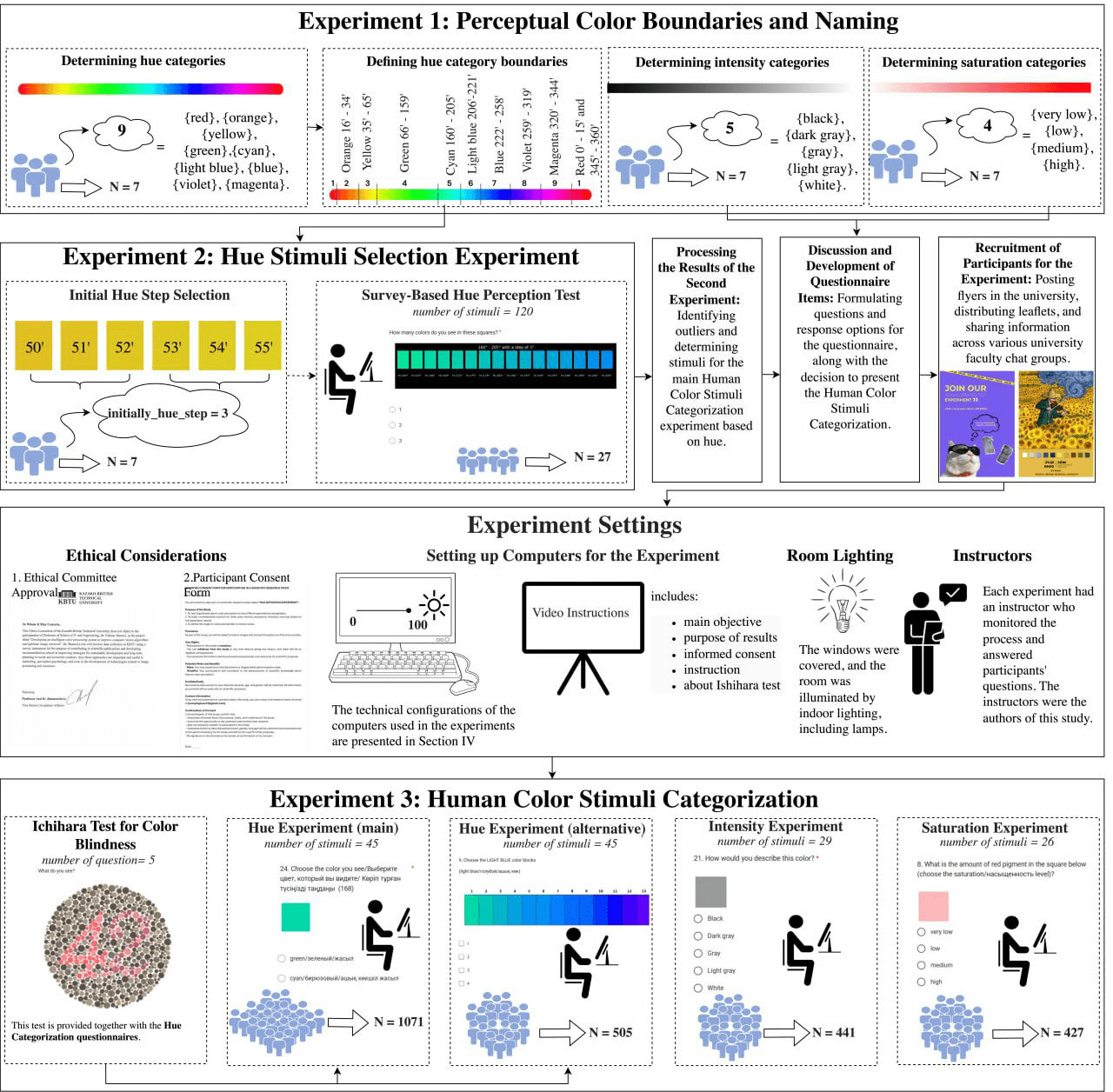
Colors are omnipresent in today's world and play a vital role in how humans perceive and interact with their surroundings. However, it is challenging for computers to imitate human color perception. This paper introduces the Human Perception-Based Fuzzy Color Model, COLIBRI (Color Linguistic-Based Representation and Interpretation), designed to bridge the gap between computational color representations and human visual perception. The proposed model uses fuzzy sets and logic to create a framework for color categorization. Using a three-phase experimental approach, the study first identifies distinguishable color stimuli for hue, saturation, and intensity through preliminary experiments, followed by a large-scale human categorization survey involving more than 1000 human subjects. The resulting data are used to extract fuzzy partitions and generate membership functions that reflect real-world perceptual uncertainty. The model incorporates a mechanism for adaptation that allows refinement based on feedback and contextual changes. Comparative evaluations demonstrate the model's alignment with human perception compared to traditional color models, such as RGB, HSV, and LAB. To the best of our knowledge, no previous research has documented the construction of a model for color attribute specification based on a sample of this size or a comparable sample of the human population (n = 2496). Our findings are significant for fields such as design, artificial intelligence, marketing, and human-computer interaction, where perceptually relevant color representation is critical.
Method
Three-phase experimental design
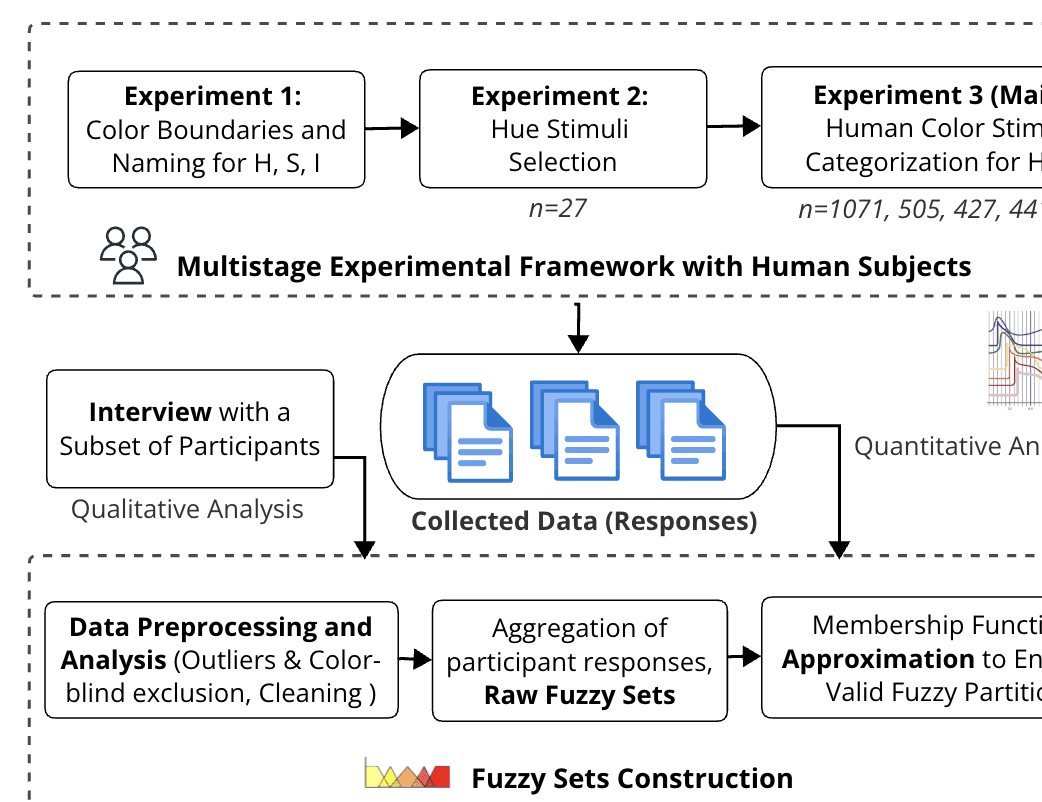
The model is not fitted to an existing color dataset — it is built from human responses. Preliminary experiments first establish which color stimuli people can actually tell apart along hue, saturation, and intensity. Those distinguishable stimuli then form the basis of a large-scale categorization survey with more than 1000 participants, growing to a total sample of 2496.
Fuzzy partitions and membership functions
Survey responses are turned into fuzzy partitions of the color space, and from those, membership functions. The point of the fuzzy formulation is that color terms genuinely overlap: a stimulus can be partly "orange" and partly "red" at the same time, and the membership functions preserve that instead of forcing a hard boundary. This is what lets the model carry real perceptual uncertainty rather than discard it.
Adaptation mechanism
The model includes a mechanism for refinement, so that membership functions can be adjusted from feedback and shifted for context rather than being frozen at the moment the survey ended.
Results
Closer to human perception than RGB, HSV, LAB
Comparative evaluation against RGB, HSV, and LAB shows COLIBRI aligning more closely with how people actually categorize color. The classical spaces are engineered for reproduction and device independence; they were never built to answer the question "what would a person call this?"
The largest sample documented for this task
At n = 2496, the study reports the largest human sample documented for building a color-attribute specification model. A side effect of the linguistic formulation is accessibility: because the model outputs color names rather than coordinates, it describes an image in terms usable by color-blind readers.
Key points
- Fuzzy color model grounded in a human survey (n = 2496), not in an existing dataset.
- Membership functions preserve overlap between color terms instead of forcing hard boundaries.
- Outperforms RGB, HSV and LAB on alignment with human categorization.
- Linguistic output makes color descriptions accessible to color-blind users.
Cite
@article{shamoi2025colibri,
  title   = {{COLIBRI} Fuzzy Model: Color Linguistic-Based Representation
             and Interpretation},
  author  = {Shamoi, Pakizar and Toganas, Nuray and Muratbekova, Muragul and
             Kadyrgali, Elnara and Yerkin, Adilet and Igali, Ayan and
             Ziyada, Malika and Adilova, Ayana and Karatayev, Aron and
             Torekhan, Yerdauit},
  journal = {IEEE Access},
  volume  = {13},
  pages   = {205932--205956},
  year    = {2025},
  doi     = {10.1109/ACCESS.2025.3638244}
}