Multi-channel Emotion Analysis for Consensus Reaching in Group Movie Recommendation Systems
arXiv preprint arXiv:2404.13778, April 2024
Adilet Yerkin, Elnara Kadyrgali, Yerdauit Torekhan, Pakizar Shamoi
School of Information Technology and Engineering, Kazakh-British Technical University
Abstract
Watching movies is one of the social activities typically done in groups. Emotion is the most vital factor that affects movie viewers' preferences. So, the emotional aspect of the movie needs to be determined and analyzed for further recommendations. It can be challenging to choose a movie that appeals to the emotions of a diverse group. Reaching an agreement for a group can be difficult due to the various genres and choices. This paper proposes a novel approach to group movie suggestions by examining emotions from three different channels: movie descriptions (text), soundtracks (audio), and posters (image). We employ the Jaccard similarity index to match each participant's emotional preferences to prospective movie choices, followed by a fuzzy inference technique to determine group consensus. We use a weighted integration process for the fusion of emotion scores from diverse data types. Then, group movie recommendation is based on prevailing emotions and viewers' best-loved movies. After determining the recommendations, the group's consensus level is calculated using a fuzzy inference system, taking participants' feedback as input. Participants (n=130) in the survey were provided with different emotion categories and asked to select the emotions best suited for particular movies (n=12). Comparison results between predicted and actual scores demonstrate the efficiency of using emotion detection for this problem (Jaccard similarity index = 0.76). We explored the relationship between induced emotions and movie popularity as an additional experiment, analyzing emotion distribution in 100 popular movies from the TMDB database. Such systems can potentially improve the accuracy of movie recommendation systems and achieve a high level of consensus among participants with diverse preferences.
Method
Three channels per film
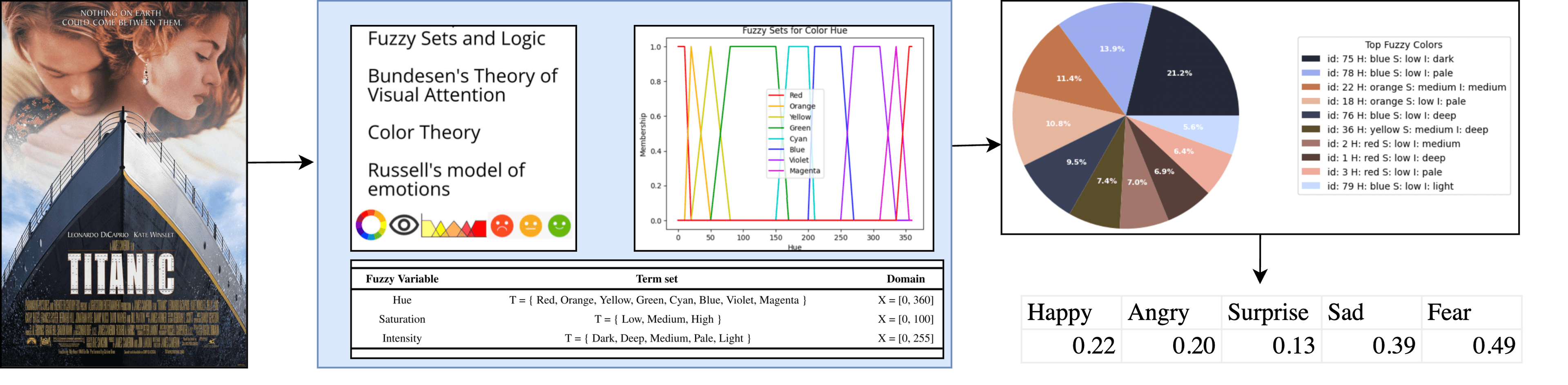
A film's emotional profile is read from three sources that carry it differently: the description (text), the soundtrack (audio), and the poster (image). Scores from these modalities are fused by weighted integration, so a film whose poster is bleak but whose soundtrack is warm ends up with a profile that reflects both rather than whichever channel was read first.
Matching people to films, then to each other
Each participant's emotional preferences are matched against candidate films using the Jaccard similarity index. Group consensus is then determined by a fuzzy inference system — the natural tool here, because agreement in a group is a matter of degree, not a binary. Recommendations are driven by the prevailing emotions of the group together with members' best-loved films.
Consensus measured, not assumed
After the recommendation is made, a second fuzzy inference system computes the group's actual consensus level from participants' feedback — closing the loop so the system reports how well it did, not only what it chose.
Results
Jaccard similarity of 0.76 across 130 participants
A survey of 130 participants across 12 films compared predicted emotion scores against the emotions people actually selected, giving a Jaccard similarity index of 0.76 — evidence that emotion detection is a workable basis for this problem rather than a plausible-sounding one.
Emotion and popularity, 100 TMDB films
A side experiment analyzed the emotion distribution of 100 popular films from the TMDB database, examining how the emotions a film induces relate to how popular it becomes.
Key points
- Emotion read from three channels — text, audio, image — and fused by weighted integration.
- Jaccard similarity for person-to-film matching; fuzzy inference for group consensus.
- Validated with 130 participants over 12 films; Jaccard index = 0.76.
- Consensus level is measured after the fact from participant feedback.
Cite
@article{yerkin2024multichannel,
  title   = {Multi-channel Emotion Analysis for Consensus Reaching in Group
             Movie Recommendation Systems},
  author  = {Yerkin, Adilet and Kadyrgali, Elnara and Torekhan, Yerdauit and
             Shamoi, Pakizar},
  journal = {arXiv preprint arXiv:2404.13778},
  year    = {2024}
}